
Permission to Question the Defaults
The Rhythm of the House
We've lived in our house for almost five years. Ever since we moved in, our bedroom has been the room it is now. And, for five years I never really questioned whether there was a better way. I’m the type of person that loves to bring new energy into rooms, but the reorganization was relegated to within the room, not fully moving or swapping rooms.
Then I saw a picture in a magazine for small space organizing, and it changed everything.
Well, not immediately. But it planted a seed. It was a small closet converted into an office with a desk tucked beneath shelves. Something about it caught me and wouldn't let go. I kept turning back to that page, and I realize now the image raised a bigger question in me: *What if you did it differently?*
At the time, our bedroom was upstairs where it had always been. Our office sat in a separate room downstairs, taking up an entire room. We had a toddler and a baby trying to share one room, and a guest room that was closed off the majority of the time when we didn’t have visitors. It all functioned, but after seeing that picture, I started seeing things in new light.
The Swap
What started as "maybe we could turn that closet into an office" became something much bigger. If the office moved into the closet, the room could become our bedroom, serving multiple purposes. If our bedroom moved downstairs, the upstairs bedroom could become a guest room. And if we did that, what was the guest room downstairs could be a nursery. No more trying to get two young children down to sleep in a single room. No more hushing our toddler as the baby napped in the main area of the house. Not only that, the guest room could serve multiple functions and me extra play space when we didn’t have visitors.
Three rooms. One chain reaction. A complete reimagining of how we moved through our home.
I won't pretend it was easy. There were weeks of sorting, hauling furniture up and down stairs, living with things downstairs that were supposed to be upstairs but we were still in the midst of things, and moments of standing in hallways wondering if we'd made a terrible mistake.
Change, even good change, has a way of feeling like chaos before it settles into something new.
But then it did settle. And what emerged surprised me.
What We Couldn't See Before
Here's what five years of habit had hidden from me: our old bedroom was inconvenient in a dozen small ways I'd simply accepted as facts of life.
The laundry room is downstairs. For five years, I carried every basket of dirty clothes down a full flight of stairs, and every basket of clean clothes back up. I didn't think of it as a problem. It was just what laundry meant in our house. But now, with our bedroom steps away from the washer and dryer, I realize how much that small friction added up. How many times I'd let the clean clothes sit in the basket because I didn't have the energy to haul them up. How the task always felt heavier than it needed to be.
Now, our new bedroom is right next to the main bathroom. The one with the towel closet beside it. Upstairs, we'd never had a towel closet. Now, replacing our towels by grabbing fresh ones from right outside the bathroom door feels like a small luxury I didn't know I was missing.
And perhaps most preciously: we have a bathroom to ourselves. With our toddler upstairs, the lower level bathroom has become ours—no baskets of tub toys to step over, no stepping on tiny toys in the middle of the night. It's a small thing. It's also not small at all.
The guest room moving upstairs opened space we didn't know we needed. The kids have room to play, to spread out with their toys, to be loud and messy and small without us all tripping over each other. We're using more of our house now. Rooms that sat quiet are full of life.
None of these revelations are revolutionary. They're obvious, even. But that's exactly the point—they were obvious solutions hiding in plain sight, obscured by the simple fact that we'd always done it another way.
The Rhythm You Don't Know You're Missing
I think about this often now as I learn traditional skills. There's a particular resistance that comes up when you first consider doing something the old way—making your own bread, culturing your own yogurt, fermenting vegetables instead of buying them in jars. The voice in your head says: “That seems like a lot of work. That seems complicated. I don't have time for that.” I can’t tell you how many people have told me “I’m so intimidated by sourdough!”
And here's what I've learned: that voice is almost always wrong.
I was also intimidated by sourdough for years. It seemed fussy and mysterious, the kind of thing that required precision and patience. But when I finally started, when I committed to diving in and learning them, its rhythms found me and something shifted. Now there's a jar of starter on my counter that I feed without thinking, the way I water a plant or rinse out my coffee cup. The bread happens alongside everything else…a few minutes here to mix, a few minutes there to shape. It fits into the margins of my day rather than demanding the center of it.
Yogurt was the same. I put it off for years, convinced it would be one more complicated thing to manage. Now I make it while I clean up dinner, and by morning, we have yogurt for the week. It takes less time than driving to the store.
These skills seemed hard before I practiced them. They seemed like they wouldn’t fit into my days. Instead, they've done the opposite. They've created a rhythm I look forward to and I didn't know was possible…a full pantry I'm proud of, money saved, the quiet satisfaction of providing something good and real for my family.
But I had to be willing to see differently first. I had to let go of the way I'd always done things to discover what I was missing.
Permission to Question the Defaults
I wonder sometimes how many inconveniences we carry simply because we've carried them for so long. How many stairs we climb that we don't need to climb. How many jars we buy that we could make ourselves. How many rhythms we've inherited from someone else's life that don't actually fit our own.
There's comfort in routine, I'm not dismissing that. There's ease in the familiar, in the paths worn smooth by repetition. But there's also a kind of stuckness that disguises itself as stability. A way of living that feels like the only option because we've never paused long enough to imagine another. Or, the hard work to achieve a different outcome seemed too menacing at the time.
Moving our bedroom downstairs didn't just change where we sleep. It changed how we move through our mornings, how laundry gets done, how the house breathes with two small children running through it. It made space (literal space) but also the harder-to-name kind.
Space for ease. Space for breath. Space for joy in the ordinary moments that make up most of our lives.
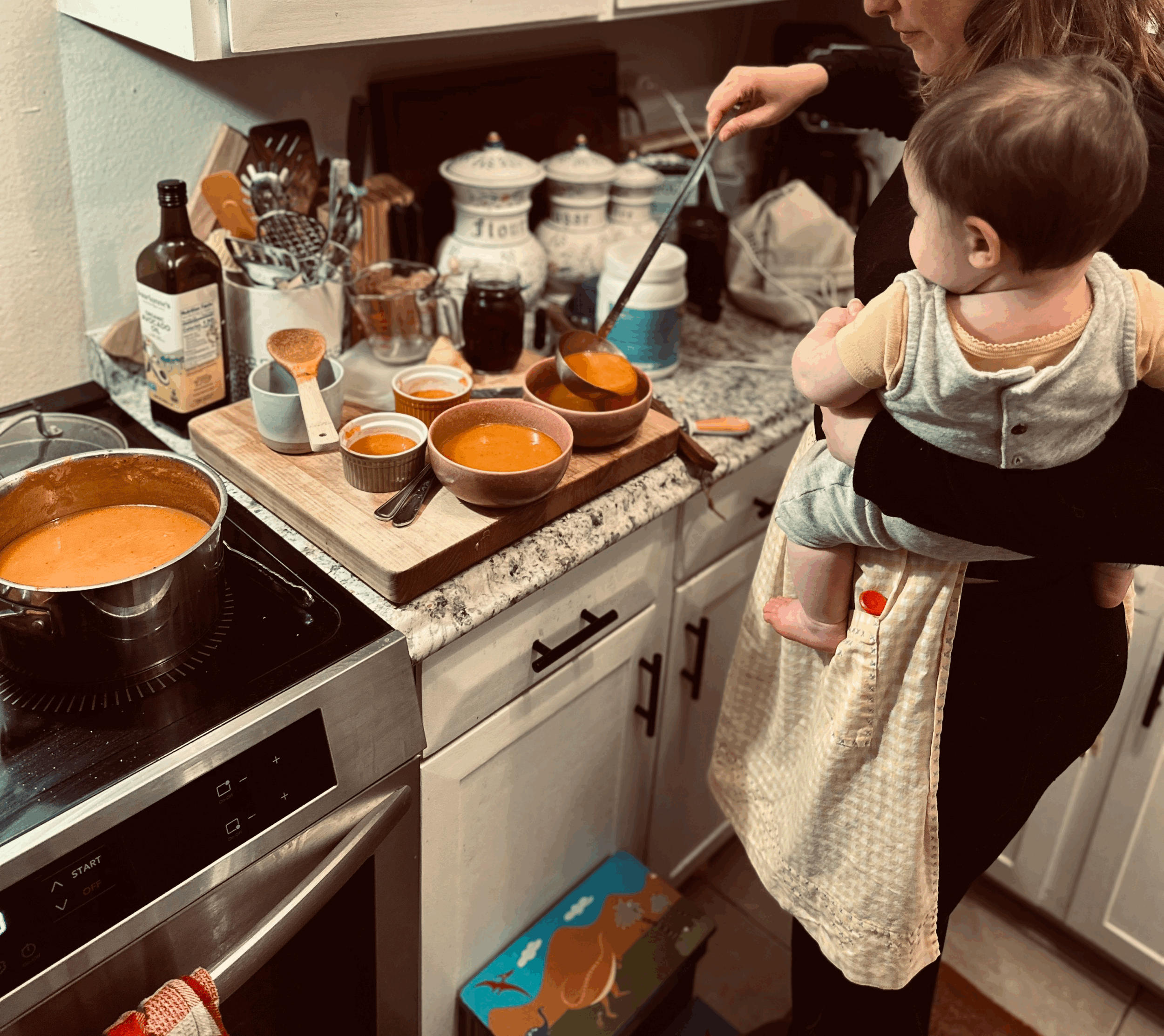
Learning to bake bread, ferment foods, pickle veggies, and culture yogurt didn't just give me new skills, it gave me a different relationship with time, with nourishment, with the rhythm of my kitchen.
It taught me that the hard thing isn't always harder, that sometimes the old way is the easier way, and that there's deep satisfaction in providing for your home with your own two hands.
Finding Your Rhythm
If you're new to traditional skills—if you're standing at the edge of sourdough or fermentation or any of the old ways, feeling like it's too much, too complicated, not for someone like you…I want to offer you this:
You don't have to see the whole path to take the first step.
You don't have to overhaul everything at once. Luckily you’re not in a position of needing to swap three rooms in your house all at once!
You can start with one jar of starter, one batch of yogurt, one small question about whether the way you've always done things is really the way they have to be done.
The rhythm will come. It always does. Not all at once, but gradually… the way bread rises, the way yogurt cultures, the way cabbage ferments.
Sometimes the invitation to change arrives quietly. A picture in a magazine. A conversation with a friend.
All you have to do is be willing to see it.
